Communities in Action for Nature™ - Participatory Conservation Methodology and Toolkit
Communities in Action for Nature™ - Participatory Conservation Methodlogy and Toolkit is an innovative, ethical board-based methodology designed to support collaborative, community-led conservation across the Gobi ecosystem. It facilitates dialogue and co-design grounded in local knowledge, priorities, and Traditional Ecological Knowledge (TEK).
This approach builds on participatory conservation and community engagement activities initiated in the early years of the Goviin Khulan Conservation Project, reflecting a long-term process of field experience, learning, and methodological refinement.
Developed within the Goviin Khulan Conservation Project by Association GOVIIN KHULAN (2025–2026), this methodology continues to evolve through field application, collaborative learning, and iterative refinement.
© 2025 Association GOVIIN KHULAN. Communities in Action for
Nature™
Participatory methodology and visual materials under development. Selected materials shared publicly for informational purposes.


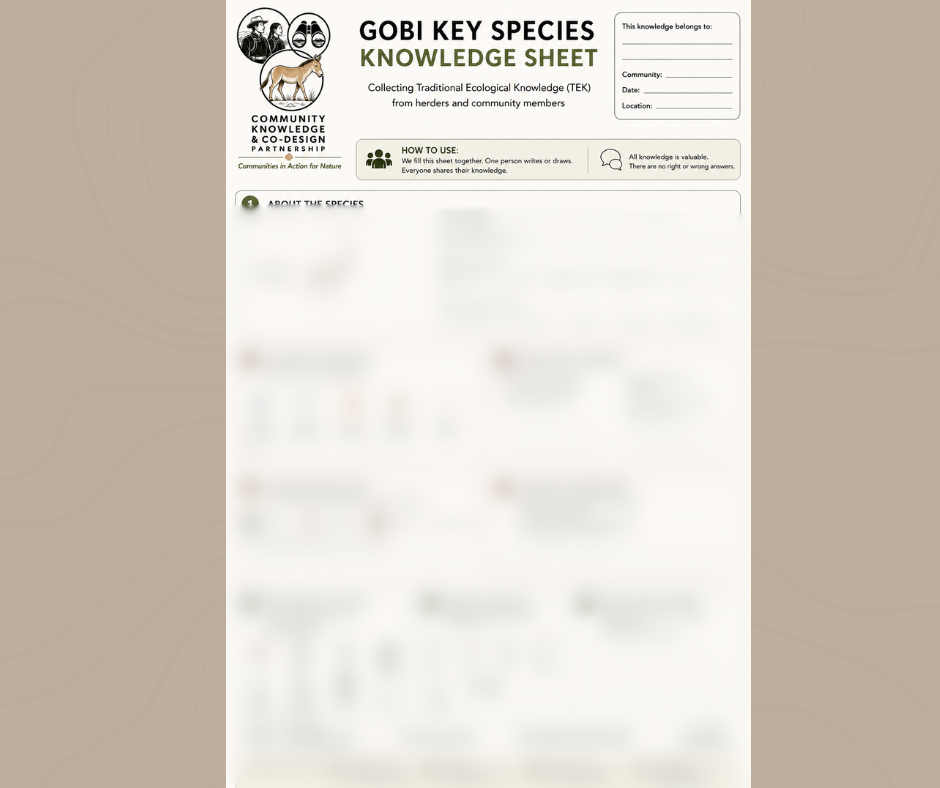


Methodological brief and implementation tools are currently under refinement and shared selectively to support appropriate contextual and ethical use.
Participatory Conservation Tools and Methodology
The activity integrates hands-on tools to facilitate meaningful community engagement:
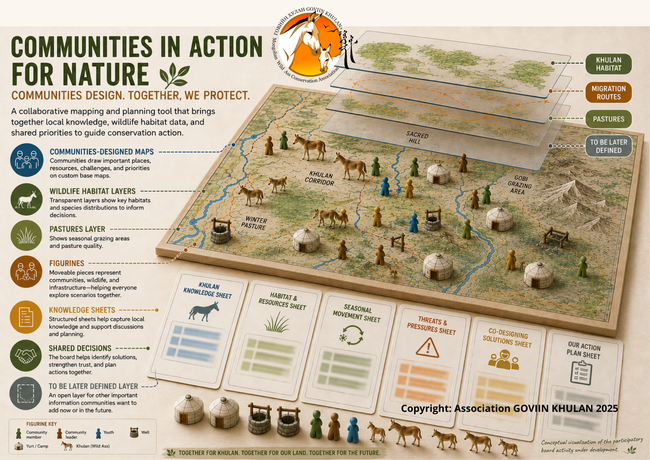
- Hand-designed, digital maps and 3D topographic representations of the landscape for enhanced spatial visualization
- Figurines representing wildlife, livestock, yurts settlements, wells and other various elements
- Theme cards covering wildlife, ecosystem services, TEK, environmental challenges, conservation strategies, conservation solutions, and cultural values — pre-designed and co-created with communities and used as facilitation tools
- Prompt-based discussion guides to document dialogue, insights, and local solutions
These tools enable community members to locate wildlife habitats, explore ecosystem services, identify environmental challenges, and co-develop practical strategies for sustainable coexistence between people, livestock, and wildlife in the Gobi region.
Spatial Visualization and Mapping for Conservation
Additional map layers allow participants to overlay critical information, including:
- Wildlife habitats
- Critical water sources
- Grazing areas
- Potential conflict zones or restoration areas
This visualization supports practical, place-based conservation planning and strengthens community-led decision-making.
Integrating Traditional Ecological Knowledge (TEK) with Conservation Science
Educational games, visual presentations, and data-based activities bridge TEK and conservation science. Participants become active local conservation leaders rather than passive observers, strengthening knowledge transfer and capacity-building.
Ethical Knowledge Sharing and Ownership
All activities follow ethical participation practices. Community members receive full access to results via photos, printed materials, or folders with updatable sheets — as successfully applied with southeastern Gobi communities since 2008. This ensures that co-designed solutions are documented and remain under community control.
All insights, knowledge, and materials produced belong to the community and will not be shared externally without prior consent, fully protecting TEK and locally-generated solutions.
Activity Modules
- TEK in Action
- TEK & Conservation in Action
- Wildlife Conservation in Action
- Human-Wildlife Coexistence in Action
- Conservation Strategies and Solutions in Action
- Nature Stewardship in Action
- Rangelands Regeneration in Action
- Young Conservationists in Action
- Additional modules will be added in coming months
Development Timeline
The full conceptual framework, operational mechanism, structural design, and all learning activities were independently developed and finalized in October 2025. The methodology was piloted and validated through various testing from October to December 2025.
Intellectual Ownership & Use Notice
Communities in Action for Nature™ is an original board-based participatory methodology independently conceived, architected, structured, and fully developed by Anne-Camille Souris for Association GOVIIN KHULAN. The framework reflects a proprietary design process, a field-tested facilitation approach, and long-term ecological and community-based conservation expertise developed in the Gobi region. All frameworks, materials, and learning tools are protected intellectual property. Reproduction, adaptation, public implementation, or redistribution requires prior written authorization. Proper attribution is required for all approved uses.
© 2025 Association GOVIIN KHULAN. All rights reserved.
1st stage of the activity development
The visuals below represent some of the figurines that have been designed for the activity but not the totality of them. These ones represent the figurines that have been developed at the very beginning and that will used with schools.


Below is a photo of a community-produced resources map, created in December 2025, with a few figurines initially created.


2026 UPDATES
March 29, 2026: Introducing a New Figurine Style for Community Engagement
As part of the development of our Communities in Action for Nature board activity, we are introducing a more realistic figurine style designed
specifically for use with local communities.
This evolution reflects our ongoing effort to adapt our tools to different contexts and audiences. While our original stylized figurines remain well suited for
school-based activities—supporting accessibility and engagement among students - this new version aims to enhance recognition and connection in community settings.
By working with more realistic representations, we support dialogue that builds on local knowledge and lived experience, helping facilitate discussions around species, ecosystems, and conservation challenges.
Both figurine styles are complementary. Together, they contribute to a shared objective: fostering inclusive, participatory approaches to conservation through tools that are meaningful, relevant,
and adaptable.


Guardians of Khulan and the Steppe


May 16, 2026
To date, a diverse set of figurines, a series of participatory prompts, and serval thematic sheets (including knowledge, fact, and co-designing
solutions sheets) have been developed as part of our community-based conservation methodology. These tools will be used and refined over the coming days and weeks.

Methodology and visual materials developed within the Goviin Khulan Conservation Project by Association GOVIIN KHULAN (2025). Selected materials are shared publicly for informational purposes. Full implementation tools and methodological resources are currently shared selectively to support appropriate contextual and ethical use.
Inspirations
While informed by earlier educational and academic initiatives, the complete conceptual architecture, operational mechanism, structural components, learning sequences, and facilitation methodology were independently designed and finalized in October 2025, with pilot testing conducted from October through the end of December 2025.
- An educational project developed by 11th Grade students of Shildeg American-Mongolian Secondary School (Ulaanbaatar) during the 2023–2024 academic year. The project focused on land connectivity for migratory species, using the Saiga antelope as a case study. Students used paper figurines placed on printed satellite maps to visualize wildlife movements and barriers such as railways. This pedagogical approach demonstrated the potential of simple figurative tools for landscape visualization and informed our reflection on accessible participatory mechanisms.
- Academic research highlighting the use of small objects and figurines to facilitate structured dialogue in participatory settings, notably the study “Serious game about the approach of nomadic pastoralists in the Gobi Desert in Mongolia” developed by Mathieu Molet and Gaëlle Lacaze (Sorbonne University, IEES Laboratory), funded by CNRS – PEPS.
Building upon these inspirations and our long-term expertise in conservation, community-based conservation and environmental education, Communities in Action for Nature™ was developed as a distinct and original conservation facilitation framework. The methodology integrates local knowledge systems, ecological science, spatial thinking, and structured participatory dialogue techniques refined through extensive field engagement with communities in the Gobi.


Activity developed by 11th Grade students in 2023-2024.

KeyConservation