Community-Driven Conservation in Mongolia's Gobi
Safeguarding critical habitats to keep wildlife, livestock, and people thriving together.
OUR VISION
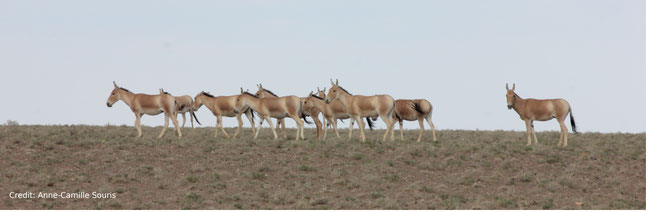
We envision populations of Khulans (Mongolian wild asses), Gobi key species, and local communities thriving together - coexisting in harmony through shared
stewardship of Mongolia’s preserved landscapes.
Healthy ecosystems support high biodiversity, allowing species and people to interact sustainably and build resilience to environmental change and emerging threats.
OUR MISSION
Association GOVIIN KHULAN's mission is to protect the Khulan (Equus hemionus hemionus) or Mongolian Wild Ass as an umbrella species and a keystone species of the Gobi Desert ecosystem, thus also enhancing protection of other Gobi key species and the Gobi Desert ecosystem, and to improve Human-wildlife coexistence and local communities' livelihood, by working closely together with local communities and protected areas.
Our Long-Term Commitment
We believe meaningful conservation grows from long-term presence. By working deeply with a small number of communities, we support the growth of trust, local leadership, and shared stewardship of land, water, and wildlife over time.
Key milestones of a long-term, community-led presence
2008
Initial engagement in the south and southeastern Gobi, focused on listening, relationship-building, and understanding local priorities around khulan conservation.
2009
Start of collaboration with rangers and administration of the Small Gobi Strictly Protected Areas, providing technical equipment and training in the use of camera traps and other field research methods to strengthen wildlife monitoring capacity.
2012
Co-design and launch of Khulan Day with the Ulgii monastery community, who selected September 18th as a day to celebrate the khulan and this species conservation.
2013
Introduction of simple, locally adapted monitoring approaches, grounded in local knowledge and long-term presence with the Ulgii monastery community.
2016
Local environmental training initiative focused on developing future trainers, implemented across two provinces and reaching approximately 70 participants.
2013–Present
Continued engagement with the same communities over more than a decade, strengthening trust, shared learning, and long-term stewardship.
2024
A herder from the southeastern Gobi (Dornogobi aimag/province) independently reaches out to join ongoing monitoring efforts — a powerful sign of local ownership, stewardship, and long-term trust built over time.
EXPECTED OUTCOMES
- Healthy and growing populations of Khulans and other Gobi key species
- Healthy rangelands benefiting people and wildlife
- Sustainable and harmonious Human-Wildlife coexistence
OUR CONSERVATION GOALS
We work alongside local communities in southeastern Mongolia’s Gobi Desert to protect the khulan (Equus hemionus hemionus) - a subspecies of the
Asiatic Wild Ass - and other key and emblematic species of the region. Our focus is on their long-term survival and on maintaining the health and connectivity of the ecosystems they depend on,
ensuring that wildlife and people can thrive together.
We advance conservation knowledge through our own fieldwork, collaboration with research groups, and by actively promoting community-based research and monitoring. By combining scientific
approaches with local knowledge, we aim to better understand wildlife, ecosystem dynamics, and the ecosystem services that sustain both people and nature.
We recognize the khulan’s ecological and cultural importance - as a symbol of Mongolia’s biodiversity and a contributor to ecosystem resilience - and work to raise awareness of its value at
local, national, and international levels.
Together with motivated herder groups and community members, we protect priority rangelands and vital water points across southeastern Mongolia’s Gobi. By safeguarding these key habitats
and the connections between them, we help maintain a resilient landscape that supports wildlife, livestock, and the communities that rely on these lands.
We also contribute to reducing and mitigating direct threats to wildlife and habitats - including illegal hunting, resource competition, and habitat pressure - through education, local monitoring, and close collaboration with communities.
Our Commitment
Our approach is grounded in respect for traditional knowledge and community leadership, ensuring that conservation benefits both people and wildlife. Rather than short-term, project-driven interventions, we focus on building lasting impact through long-term presence, trust, and genuine care for the land, the wildlife, and the communities who depend on them.
OUR VALUES

- Passion: We have a strong passion for the Khulan, wildlife, Mongolia, and our work.
- Creativity: We always bring new ideas to make our conservation efforts efficient and adapt to changes and challenges.
- Adaptability: We are resilient and adapt to changes and failures.
- Integrity: We do what is right to do.
- Results-oriented: We focus on meaningful and sustainable impacts.
- Collaboration: We believe that together we can have greater impacts.
- Diversity: We care about our team members and the communities we work with.
- Holistic Mindset: For us everything is connected: healthy ecosystems and preserved biodiversity benefit the species we work to protect, local communities, government agencies and corporations.
OUR CONSERVATION ACTIVITIES
Scientific research - We conduct research, and partner with other scientific teams on several aspects of biodiversity, ecology and wildlife behavioral ecology.
Capacity building
- We provide professional training to protected areas' staff and rangers we cooperate with in order to enhance their knowledge and skills about ecology and biodiversity conservation as well as about research methods. We are developing a specific curriculum for protected areas that will contain on-site, in-the-field and online training and knowledge assessment activities.
- We also provide training and support to some members of the local communities (herders, Buddhist monks and more) to empower them as 'Guardians of Nature and Wildlife' and as 'Citizen conservationists' to improve protection of the Khulan, Gobi key species and their habitat. These communities' members live in our study areas all year round and depend on a healthy ecosystem to survive. They can also provide an invaluable contribution to the long-term success of protection of Gobi wildlife and their habitat.
Community-based and led conservation activities
- We involve some members of the local communities in our conservation activities as Guardians of the Khulan and Nature, and as Khulan and Biodiversity Conservation Ambassadors,
- We empower some members of the local communities to initiate and lead their own conservation activities,
- We partner with already existing community-led conservation groups in our project's areas.
Local culture and traditions in support to biodiversity conservation
- We work with Buddhist monks from our study area to reinforce links between Mongolian culture and traditions with conservation of the Mongolian Khulan, Gobi wildlife and the Gobi ecosystem.
- We also work with Mongolian artists to elevate the Khulan to the status of a symbol representing the rich biodiversity and cultural heritage of Mongolia.
Environmental education and awareness - We conduct conservation education and awareness activities in the Gobi Desert
(including secondary schools) to inform, engage and empower the local community and the youth community in wildlife and natural resources protection. We produce exclusive educational
resources such as educational brochures, monitoring brochures, cartoons and children's books in collaboration with local artists and designers.
Participatory research, citizen science, responsible and conservation tourism - We organize, in partnership with locally based and
international travel agencies, wildlife observation, ecotourism and citizen science expeditions in our study area and other areas of Mongolia, during which travelers can: observe a high variety
of wildlife, be involved in some of our research and conservation activities and meet with our local scientific assistants and members of our study area's local community.
ETHICAL CONSERVATION
Ethical Conservation supports ethical, equitable, and inclusive nature conservation efforts that are supported and led by local communities.
Since the launching of our conservation program, local communities of our project areas have been always at the center of our conservation efforts.
Since the beginning, we are committed to conduct conservation activities that are ethical, equitable, fair and sustainable, ensuring a future where human rights, animal welfare and ecological health are connected and balanced.
OUR CONSERVATION STRATEGY 2025-2030




Our Conservation Strategy for 2025-2030 (short form)

🌿Join us in protecting Mongolia’s biodiversity hand-in-hand with local communities
Donate Now
KeyConservation